





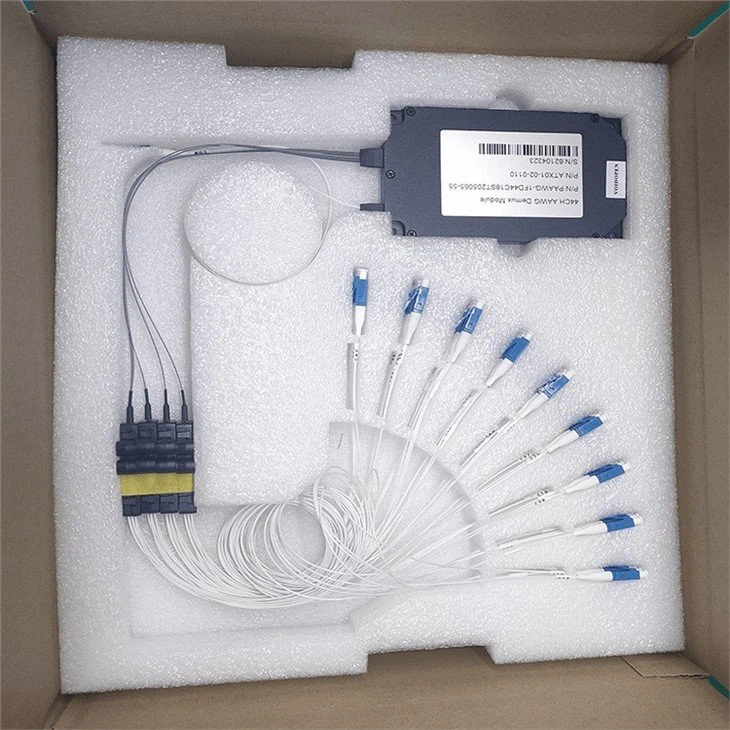
32 Channel DWDM AAWG Passive Module
The 32-channel DWDM AAWG passive module is a high-performance optical device that can be used in optical communication, data center, optical transmission, optical monitoring and other fields. The module adopts AAWG technology, which has excellent performance and reliability, and can realize optical signal transmission with high density and high channel count. If you need more information and services about this product, please contact us, we will wholeheartedly provide you with high-quality products and services.

- Product Introduction
The 32-channel DWDM AAWG passive module is a high-performance optical device that can be used in optical communication, data center, optical transmission, optical monitoring and other fields. The module adopts AAWG technology, which has excellent performance and reliability, and can realize optical signal transmission with high density and high channel count. If you need more information and services about this product, please contact us, we will wholeheartedly provide you with high-quality products and services.
This module can be used in long-distance optical transmission systems, supporting application scenarios such as optical fiber communication and optical cable transmission. This module can be used for interconnection within the data center to achieve high-speed, high-bandwidth data transmission and improve the transmission efficiency and reliability of the data center. This module can be used in an optical monitoring system to monitor and analyze optical signals and ensure the stability and reliability of optical signals.
Product Features
1. High number of channels: The module supports 32 channels, which can realize high-density and high-throughput optical signal transmission to meet customers' needs for high speed and high bandwidth.
2. Excellent performance: The module adopts AAWG technology, which has excellent performances such as low insertion loss, low in-band ripple, and high out-of-band rejection ratio, which can ensure the stability and reliability of optical signals.
3. Wide wavelength range: The center wavelength of the module is 1550nm and the bandwidth is 0.1nm, which can support a wide wavelength range from C-band to L-band, meeting the needs of different application scenarios.
4. Strong thermal stability: The thermal stability of the module is ≤20pm/℃, and the wavelength stability is ≤0.005nm/℃, which can maintain stable performance under different ambient temperatures and ensure the quality and reliability of optical signal transmission.
5. Small size: The size of the module is 145mm x 78mm x 8mm, which is small and suitable for use in compact optical equipment.
6. Easy to install: The optical fiber connection of this module adopts FC/APC interface, the insertion loss is ≤5dB, and it can be installed in the optical equipment conveniently and quickly.
Product Image


Product Applications
1. Optical communication field: This module can be used in optical fiber communication systems, supporting long-distance optical transmission and high-speed, high-bandwidth data transmission, ensuring the reliability and stability of data transmission.
2. Data center field: This module can be used for interconnection within the data center, supports high-density, high-bandwidth data transmission, and improves the transmission efficiency and reliability of the data center.
3. Optical transmission field: This module can be used in optical cable transmission systems, supporting long-distance transmission of optical cables and high-density optical signal transmission, ensuring the quality and reliability of optical signal transmission.
4. Optical monitoring field: This module can be used in optical monitoring systems to monitor and analyze optical signals and ensure the stability and reliability of optical signals.
5. Optical sensing field: This module can be used in optical sensing systems to realize the measurement and monitoring of physical quantities, such as temperature, pressure, deformation, etc., and can be widely used in medical, environmental protection, industrial and other fields.
Product Parameters
| Number of channels | 32 | Working wavelength range | C-band or L-band |
| Working wavelength accuracy | ±0.05nm | Insertion Loss | ≤5dB |
| Bandwidth | 100GHz | Adjacent channel isolation | ≥25dB |
| Non-adjacent channel isolation | ≥30dB | Wavelength temperature stability | ≤0.005nm/℃ |
| Wavelength Repeatability | ≤0.003nm | Relative Power Response | ±0.5dB |
| Relative Group Delay | ≤20ps | Cross Modulation Saturation Power | ≥10dBm |
Instructions For Use
1. Install the module in the optical equipment, and ensure that the optical fiber connection adopts FC/APC interface, and the insertion loss is ≤5dB.
2. Input the optical signal to be transmitted to the input port of the module, and the input port and output port can be connected by optical fiber connection.
3. Adjust the working wavelength of the module to ensure that the input optical signal can be converted into wavelength division multiplexing in the module to realize 32-channel optical signal transmission.
4. Connect the output port of the module to the input port of the target device, making sure that the connected fiber has good quality and stability.
5. Monitor the transmission quality of the optical signal, detect and analyze the optical signal through optical power meter and other equipment to ensure the stability and reliability of the optical signal.
Terms Of Use
1. Please read the product manual carefully before installation to ensure that the installation process is correct to avoid damage to the equipment and affect the quality of optical signal transmission.
2. Please pay attention to anti-static during installation to avoid damage to equipment caused by static electricity, and use anti-static tools and equipment at the same time.
3. During the installation process, please pay attention to the quality and stability of the optical fiber connection to avoid the influence of poor or disconnected optical fiber connection on optical signal transmission.
4. Please pay attention to the ambient temperature and humidity during use, and avoid the impact of excessively high or low ambient temperature and humidity on the device.
5. Please pay attention to the cleaning and maintenance of the equipment during use, avoid the influence of dust and dirt on the equipment, and maintain and check the equipment regularly.
6. Please pay attention to the monitoring of optical power and wavelength during use to ensure the stability and reliability of optical signal transmission, and at the same time prevent optical power and wavelength from exceeding the working range of the device.
Customer Comments
A communications engineer in Los Angeles, CA commented:
Optical communication experts in Munich commented:
An optical communication engineer in Winnipeg commented:
Brisbane-based communications consultants commented:
An optical communication engineer in Kyoto commented:
Related Blogs
Product Video


