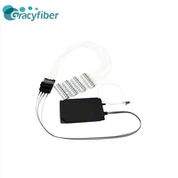
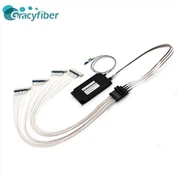
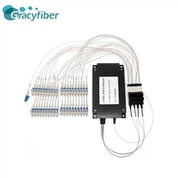
100G 40-Channel Flat Top Athermal AAWG Module
The 100G 40-channel flat-top athermal AAWG module is a high-performance optical communication device. It adopts the flat-top athermal AWG (Arrayed Waveguide Grating) technology, which can achieve high channel density and excellent channel uniformity, while having a lower insertion loss and lower crosstalk. This module is mainly used in data center, optical transmission network, optical switching network, optical access network and other fields. It can realize high-speed, stable and reliable optical signal transmission and multiplexing, and meet the needs of different users for high-speed optical communication.

- Product Introduction
The 100G 40-channel flat-top athermal AAWG module is a high-performance optical communication device. It adopts the flat-top athermal AWG (Arrayed Waveguide Grating) technology, which can achieve high channel density and excellent channel uniformity, while having a lower insertion loss and lower crosstalk. This module is mainly used in data center, optical transmission network, optical switching network, optical access network and other fields. It can realize high-speed, stable and reliable optical signal transmission and multiplexing, and meet the needs of different users for high-speed optical communication.
The working principle of the 100G 40-channel flat-top athermal AAWG module is to distribute multiple input signals to different waveguides, then multiplex and demultiplex the signals through the AWG, and finally combine the output signals. The flat-top athermal AWG technology adopts a certain waveguide structure and optical design, so that the output optical power presents a flat-top distribution, thereby achieving better channel uniformity and lower insertion loss.
Product Features
1. High channel density: 100G 40-channel flat-top athermal AAWG module supports 40 channels. Compared with traditional optical communication devices, its channel density is higher, which can achieve higher data transmission rates and more user access requirements .
2. Low insertion loss: The module adopts flat-top athermal AWG technology, which can achieve lower insertion loss and improve signal transmission efficiency and quality compared with traditional AWG technology.
3. Excellent channel uniformity: using flat-top athermal AWG technology, the output optical power of the module presents a flat-top distribution, which can achieve better channel uniformity, avoid power differences between channels, and improve the stability of signal transmission and reliability.
4. Lower crosstalk: The module adopts flat-top athermal AWG technology, which can achieve lower crosstalk than traditional AWG technology, avoid optical signal interference between adjacent channels, and improve signal transmission quality and rate.
5. High-speed data transmission: 100G 40-channel flat-top athermal AAWG module can achieve a data transmission rate of up to 100Gbps, which can meet the needs of different users for high-speed and large-capacity optical communication.
6. Wide wavelength range: The module supports a wide range of working wavelengths, covering the wavelength range of 1260nm-1620nm, suitable for different application scenarios.
7. High temperature stability: The module adopts advanced optical design and manufacturing process, which can achieve high temperature stability and maintain good performance in a wide temperature range.
Product Image


Product Applications
1. Data center: With the development of cloud computing, big data, artificial intelligence and other technologies, the demand for high-speed, large-capacity, and high-stability optical communication in data centers continues to increase. The 100G 40-channel flat-top athermal AAWG module can realize high-speed, stable and reliable optical signal transmission and multiplexing, meeting the needs of data centers for high-speed optical communication.
2. Optical transmission network: Optical transmission network refers to the transmission of optical signals through optical fibers to realize data transmission and communication between different locations. The 100G 40-channel flat-top athermal AAWG module can achieve a data transmission rate of up to 100Gbps, which can meet the needs of optical transmission networks for high-speed and large-capacity optical communications.
3. Optical switching network: Optical switching network refers to the switching and transmission of optical signals through optical switches. The 100G 40-channel flat-top athermal AAWG module can realize high-density channel multiplexing and demultiplexing, and can meet the needs of optical switching networks for high-density, high-speed, and reliable optical communications.
4. Optical access network: The optical access network refers to connecting optical fibers to users' homes or enterprises to achieve high-speed and stable optical communication. The 100G 40-channel flat-top athermal AAWG module can realize high-speed, stable and reliable optical signal transmission and multiplexing, and can meet the needs of optical access networks for high-speed optical communications.
Product Parameters
| Working wavelength range | 1260nm-1620nm | Number of Channels | 40 channels |
| Channel Spacing | 100GHz | Channel Uniformity | ±0.05dB |
| Channel insertion loss | ≤5.5dB | Channel isolation | ≥25dB |
| Management interface | RS232 | Power supply method | Single 12V power supply |
| Power Consumption | ≤5W | Working temperature range | 0℃-70℃ |
Instructions For Use
1. Check the equipment: Before use, you need to check whether the equipment is in good condition, including whether the connection port of the module is clean, whether the optical fiber is connected correctly, and whether the power supply is normal, etc.
2. Connect the optical fiber: Connect the optical fiber to the input port and output port of the module, make sure the connection is correct.
3. Connect the power supply: Connect the power supply of the module to ensure that the power supply is normal.
4. Set the wavelength: Set the working wavelength range of the module according to the needs. Usually, the module supports the wavelength range of 1260nm-1620nm, and set it according to the actual application requirements.
5. Set channels: Set the number of channels of the module according to the needs. The module supports 40 channels, which can be set according to specific needs.
6. Verify the signal: use the signal source to verify whether the input and output signals of the module are normal, and check whether there are problems such as signal loss and crosstalk.
7. Adjust parameters: According to the actual application requirements, adjust the parameters of the module, including parameters such as gain and average power, to achieve the best signal transmission effect.
Terms Of Use
1. Avoid mechanical damage: Avoid mechanical damage during use, such as collision, vibration, etc., so as not to affect the performance and stability of the module.
2. Avoid electrostatic interference: Before use, it is necessary to avoid electrostatic interference, such as using electrostatic protection equipment, operating in a dry environment, etc., so as not to affect the performance and stability of the module.
3. Avoid temperature changes: Avoid excessive temperature changes during use, so as not to affect the performance and stability of the module. It is recommended to operate in an environment with relatively stable temperature.
4. Pay attention to the fiber connection: When connecting the fiber, pay attention to the correctness and quality of the connection, such as the cleaning of the fiber and the strength of the connection, so as not to affect the transmission effect and stability of the signal.
5. Pay attention to the power connection: When connecting the power supply, pay attention to the stability and voltage level of the power supply, so as not to affect the performance and stability of the module.
6. Pay attention to the wavelength setting: the wavelength setting needs to be set according to the actual application requirements, so as not to affect the transmission effect and stability of the signal.
7. Pay attention to the channel setting: the channel setting needs to be set according to the actual application requirements, so as not to affect the transmission effect and stability of the signal.
Customer Comments
Communications Engineers in California commented:
A network architect in Berlin, Germany commented:
Communication technology specialist in San André, São Paulo state:
An optical communication engineer in Sydney, Australia commented:
A communications consultant in Vancouver, Canada commented:
Related Blogs
Product Video
You Might Also Like