5G Fronthaul Solutions - Gracyfiber
A component of the metro access layer is 5G fronthaul. The network features of 25Gb/s optical modules determine their high level of demand. The network of the fronthaul has more notes, and purchasers are probably concerned with price. For 5G fronthaul, there are now three basic options: fiber direct connection, passive WDM, and active WDM/OTN.

- Product Introduction
5G has moved part of the physical layer of the original BBU (baseband unit) in the 4G era to AAU (active antenna unit). Also, the interface has been changed from the original 100Gbit/s CPRI to 25Gbit/s. And the non -real-time functions of the BBU are moving up to the CU (centralized unit) to make preparations for the clouding network. In this way, the DU (distribution unit) is the only part of the BBU. In other words, the 5G access network has evolved from the two-tier architecture of the BBU and RRU to the three-tier architecture of CU, DU, and AAU. This not only ensures high bandwidth and low latency of the network but also contributes to flexible scheduling, network protection , and management control.

A component of the metro access layer is 5G fronthaul. The network features of 25Gb/s optical modules determine their high level of demand. The network of the fronthaul has more notes, and purchasers are probably concerned with price.
For 5G fronthaul, there are now three basic options: fiber direct connection, passive WDM, and active WDM/OTN.
5G Front-haul Application
Fiber Direct Connection
The general transmission distance of the CPRI and eCPRI interfaces in the fronthaul is controlled within 10km, so point-to-point optical fiber direct connections can be used between the BBU/DU and each AAU port.
The optical fiber direct connection solution is simple and easy to implement, and can meet the requirements of the fronthaul bearer. But the biggest problem is that fiber resources take up a lot. In the 5G era, with the sharp increase in the number of 5G fronthaul bandwidths, base stations, and carrier frequencies, the optical fiber direct drive solution cannot be ignored. The feature of this solution is that the deployment cost is relatively low, but it is limited by the fiber resources at the end. It is suitable for scenarios with abundant fiber resources and small-scale centralized BBU/DU.

Passive WDM Connection
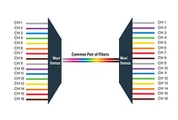
Passive WDM connection can multiplex several wavelengths and transmit them on a pair of or a single fiber to connect multiple AAUs to DUs to save fiber. Passive mux/demux can be deployed together with AAU to handle single-station service or can be deployed at optical intersection sites to converge multi-station service.

Active WDM/OTN
Active WDM/OTN/SPN connection needs to deploy OTN devices (such as WDM Mux/Demux, OADM, EDFA, OEO, etc.) between the AAU site and DU equipment room. It also utilizes WDM technology and provides multiple AAU to DU connections by using a pair of optical fiber or single fiber. Usually, the 10G/25G grey light optical modules with a short transmission distance are applied for connecting AAU/DU with WDM/OTN/SPN. The connections between WDM/OTN/SPN network devices can be achieved by 10G/25G/50G/100G dual-fiber or single-fiber bidirectional fiber optic transceivers. Compared with the passive WDM solution, the active WDM connection is more flexible and more cost-effective, which can be deployed easily, it is likely to be gradually used by 5G.

Solution Features
Support for Multiple Frequency Bands
5G operates across a variety of frequency bands, including both sub-6 GHz and mmWave frequencies. Fronthaul solutions must support these various bands to ensure compatibility with different 5G deployments.
Synchronization
Accurate time and phase synchronization are crucial for 5G networks, especially for advanced applications like beamforming and coordinated multi-point (CoMP) transmissions. Fronthaul solutions need to provide mechanisms for precise synchronization across network elements.
Low Total Cost of Ownership (TCO)
Fronthaul solutions should offer cost-effective deployment and maintenance options to help network operators manage their investments while delivering the benefits of 5G technology.
Overall, 5G fronthaul solutions are a critical component of the 5G ecosystem, enabling the high-performance and low-latency connectivity required to support the wide range of applications and services that 5G networks will power.
Related Blogs
Product Video