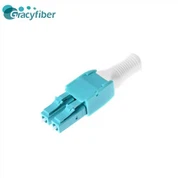
Duplex Fiber Optic Connector-Telecom Fiber Optic Adapter
A duplex fiber optic connector is a connector for fiber optic communication that allows simultaneous bi-directional communication on a single fiber. While traditional single-mode fiber optic connectors only allow unidirectional communication, duplex fiber optic connectors allow optical signals to be transmitted in both directions simultaneously by using two separate optical paths in the fiber.

- Product Introduction
A duplex fiber optic connector is a connector for fiber optic communication that allows simultaneous bi-directional communication on a single fiber. While traditional single-mode fiber optic connectors only allow unidirectional communication, duplex fiber optic connectors allow optical signals to be transmitted in both directions simultaneously by using two separate optical paths in the fiber. There are several types of duplex fiber optic connectors, the common ones include SC (Subscriber Connector) connectors and LC (Lucent Connector) connectors. They are both miniaturized, high-density and low insertion and removal losses, and are suitable for high-speed fiber optic communication systems.
Duplex fiber optic connectors usually use two fiber optic sockets, one for sending optical signals and the other for receiving optical signals. These two sockets are connected to the transmitting and receiving fiber, allowing the optical signal to be transmitted in both directions. These connectors are typically used in applications that require simultaneous bi-directional communication, such as network communications, data centers, and telecommunication systems.
Product Features
1.High quality connection: Duplex fiber optic connectors use precision manufacturing process to ensure the stability and reliability of the connection between optical fibers. It can effectively reduce signal loss and interference and provide high quality data transmission.
2. Flexibility and compatibility: Duplex fiber optic connectors are compatible with SC/PC interfaces and can be used with a variety of fiber optic devices and fiber optic cables. Whether single-mode fiber or multimode fiber, it can provide excellent connection performance.
3. Easy installation: Duplex fiber optic connectors are plug-in design, easy and fast installation. Users simply insert the fiber into the connector to complete the connection, no additional tools or complex operations.
4. High-speed transmission: Duplex fiber optic connectors support high-speed data transmission, which can meet the needs of large-capacity data transmission. Whether it is HD video, cloud computing or big data applications, it can provide stable and efficient transmission performance.
5. Reliability and stability: Duplex fiber optic connectors are manufactured with high quality materials, which have good durability and anti-interference capability. It is able to maintain stable connections in various harsh environments to ensure the reliability of data transmission.
Product Image

Product Applications
1. Data center networks: Duplex fiber optic connectors play an important role in data center networks. Data centers often require high-speed, reliable bi-directional communications to support large-scale data transmission and processing. Duplex fiber optic connectors meet these needs and can effectively utilize limited space due to their miniaturization and high density.
2. Telecom systems: In the telecom field, duplex fiber optic connectors are widely used in fiber optic communication networks. These networks require simultaneous bi-directional communication to support the transmission of services such as telephone, Internet and TV. The high performance and reliability of duplex fiber optic connectors make them ideal for telecom systems.
3. Video surveillance systems: With the popularity of video surveillance systems, duplex fiber optic connectors are also widely used in the field of video transmission. Video surveillance systems usually require real-time video transmission and bi-directional audio communication to ensure security and surveillance effectiveness. Duplex fiber optic connectors can provide high quality video transmission and bi-directional communication to meet the needs of video surveillance systems.
4. Medical equipment: In medical equipment, duplex fiber optic connectors can be used for fiber optic communication and data transmission. For example, medical imaging equipment requires high speed and reliable data transmission to support doctors to make accurate diagnosis and treatment of patients. The high performance and stability of duplex fiber optic connectors make them an important part of medical equipment.
5. Research and laboratory: In the field of research and laboratory, duplex fiber optic connectors are widely used for optical experiments and data transmission. Researchers and scientists need high precision optical equipment and bi-directional communication for experiments and data collection. Duplex fiber optic connectors can provide stable optical connections and high-speed bidirectional data transmission to meet the needs of research and labs.
Product Parameters
| Connector Type | Duplex Fiber Optic Connectors | Fiber Type | Singlemode/Multimode |
| Insertion Loss | 0.2 dB or less | Return Loss | -40 dB or more |
| Operating wavelengths | 1310nm and 1550nm or 850nm and 1300nm | Protection class | IP67 |
| Max. number of connections | 1000 or more times | Temperature Range | -40°C to 85°C |
Instructions For Use
1. Preparation: Make sure you have the proper duplex fiber optic connectors, as well as the required fiber optic cables and equipment. Confirm that you have understood the basic principles and safety procedures for fiber optic connections.
2. Connection preparation: Determine the equipment you want to connect and the type of fiber optic connector (e.g. LC, SC, ST, etc.). Clean the end of the fiber optic connector and make sure there is no dust or dirt on its surface.
3. Connection steps: Insert the end of the fiber optic connector into the fiber optic interface of the device, making sure the plug is properly aligned. Gently rotate the connector until you feel that it is fully inserted and tightly connected to the device. Repeat the above steps to insert the other end of the fiber optic connector into the fiber optic interface of the other device.
4. Test the connection: Using a fiber optic tester or other appropriate equipment, check that the connection is successfully established. Make sure the stability of the connection and the signal quality are as required.
Terms Of Use
1. Select the appropriate connector type: There are various types of duplex fiber optic connectors, such as LC, SC, ST, etc. When selecting a connector, make sure it is compatible with your equipment and fiber type, and choose the appropriate connector type as needed.
2. Clean the connector end: Always make sure the connector end is clean before connecting the fiber. Use a special fiber optic cleaning tool or cleaner to gently wipe the connector ends to remove impurities such as dust, dirt or grease.
3. Use appropriate tools: Use appropriate tools to operate the connector during installation and connection. Avoid using excessive force or inappropriate tools that may damage the connector or fiber.
4. Regular inspection and maintenance: Check the condition of the connector regularly and perform necessary maintenance. Clean the connector ends, check for loose or damaged connections, and repair or replace defective connectors in a timely manner.
Customer Comments
Emily Johnson from New York State, USA comments:
Hans Schmidt from Munich, Germany comments:
Sato Hiroshi from Osaka, Japan commented:
Sophie Dubois from Marseille, France, commented:
Liam Wilson from Melbourne, Australia, commented:
Related Blogs
Product Video
You Might Also Like