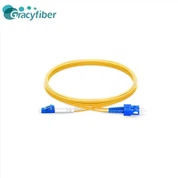
LC to LC Fiber Patchcord-LC to LC UPC Duplex Patchcord
LC to LC fiber optic patch cable is a high-performance fiber optic interconnection product for data centers, computer rooms, communication rooms and other occasions. The product adopts LC interface, with easy plugging and unplugging, high transmission rate, strong anti-interference ability, etc., which can meet the needs of high-speed data transmission.

- Product Introduction
LC to LC fiber optic patch cable is a high-performance fiber optic interconnection product for data centers, computer rooms, communication rooms and other occasions. The product adopts LC interface, with easy plugging and unplugging, high transmission rate, strong anti-interference ability, etc., which can meet the needs of high-speed data transmission.
The product adopts high quality optical fiber material, which has the characteristics of low loss, high transmission rate and low refractive index, which can ensure the stability and reliability of data transmission. At the same time, the product also uses high-quality connectors, with low insertion loss, high return loss and other characteristics, to ensure the quality of optical signal transmission.
LC to LC fiber optic patch cable also has flexibility and scalability, users can choose different lengths of fiber optic patch cable as needed to meet the needs of different occasions. In addition, the product also has durability and stability, which can maintain good performance and stability in long time use.
Product Features
1. High-speed transmission: LC to LC fiber optic patch cable adopts high-quality fiber optic materials and connectors, with low loss, high transmission rate, low refractive index, etc., which can realize high-speed data transmission.
2. Stable and reliable: LC to LC fiber optic patch cable uses high quality fiber optic materials and connectors, with low insertion loss, high return loss, etc., to ensure the quality of optical signal transmission, but also has the durability and stability, can maintain good performance and stability in a long time use.
3. Flexible and scalable: LC to LC fiber optic patch cord can be selected according to user needs with different lengths of fiber optic patch cords to meet the needs of different occasions, and different numbers of connectors can be selected as needed to achieve a more flexible fiber interconnection.
4. Easy to install: LC to LC fiber patch cable adopts LC interface, with easy plugging and unplugging, stable connection, etc. It can be quickly and easily installed and removed.
Product Image

Product Applications
1. Data Center: LC to LC fiber optic patch cables are widely used to connect between servers, storage devices, network switches and other devices in data centers. Due to its compact size and high speed transmission performance, it can meet the demand of data center for high density and high speed.
2. Enterprise network: LC to LC fiber patch cable is also widely used in enterprise network for connecting network equipment between different floors and different server rooms, such as switches, routers, firewalls, etc.. Its high-speed transmission performance and stable connection quality can ensure the efficient and stable operation of enterprise networks.
3. Telecom: LC to LC fiber optic patch cable is also one of the important applications in the field of telecommunication. It is used to connect different fiber optic cables, optical modules, optical amplifiers and other devices for signal transmission and expansion.
4. Broadcast TV: In the field of broadcast TV, LC to LC fiber optic patch cable is widely used to transmit high definition video signals and audio signals. It can ensure the transmission quality of HD video and audio signals, thus improving the viewing experience of broadcast TV.
5. Security monitoring: In the field of security monitoring, LC to LC fiber optic patch cable is used to connect surveillance cameras and monitoring equipment for video signal transmission. Due to its high-speed transmission performance and stable connection quality, it can ensure the efficient and stable operation of the surveillance system.
Product Parameters
| Fiber Type | 9/125μm Singlemode Fiber | Cable Length | 3m, 5m, 10m, 15m |
| Connector Type | LC to LC | Optical loss | ≤0.3dB |
| Return Loss | ≥50dB | Operating Wavelength | 1310nm/1550nm |
| Operating temperature | -40℃~+75℃ | Storage Temperature | -45℃~+85℃ |
Instructions For Use
1. Confirm the connected device: First, you need to confirm the interface type of the device to be connected and the fiber optic patch cable to make sure they match. both ends of the LC to LC fiber optic patch cable are LC interface, so you need to confirm the connected device is also LC interface.
2. Prepare the fiber optic patch cable: Remove the LC to LC fiber optic patch cable from the package and check the appearance of the fiber optic patch cable to make sure it is intact.
3. Connect the fiber optic patch cable: Plug one end of the LC to LC fiber optic patch cable into the LC interface of one device and the other end into the LC interface of the other device. Note: When inserting the fiber optic patch cable, make sure the plug is oriented correctly to avoid damaging the device.
4. Check the connection: After the connection is completed, you need to check if the connection is stable. You can use tools such as fiber optic tester or optical power meter to check the optical signal strength and quality of the connection.
5. Complete the connection: After the connection is successful, you can start using the connected device for data transmission or communication.
Terms Of Use
1. Please check the fiber optic cable and connectors for damage or contamination before installation, and replace or clean them if there is any problem.
2. Please make sure the fiber optic cable length and connector type match the equipment requirements before installation to avoid any mismatch.
3. Please avoid excessive bending or stretching of the fiber optic cable during installation to avoid damage to the cable.
4. When plugging and unplugging the connector, please take care to hold it gently and avoid excessive force or shaking to avoid damage to the connector and the equipment.
5. When using, please keep the connector and the interface of the device clean to avoid dust or dirt, which may affect the signal transmission quality.
Customer Comments
John from New York, NY, USA, who commented:
Linda from Vancouver, Canada, commented:
David from Sydney, Australia, commented:
Sarah from Auckland, New Zealand, commented:
Peter from Johannesburg, South Africa, commented:
Related Blogs
Product Video