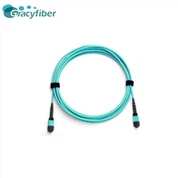
LAN Fiber Optic Patch Cable-MU Fiber Optic Patch Cable
MU fiber optic patch cable is a high quality fiber optic connection cable, using single mode fiber, capable of transmitting signals in the wavelength range of 1310nm and 1550nm. Its insertion loss is less than 0.2dB, reflection loss is more than 60dB, repeatability is less than 0.1dB, durability is less than 0.2dB, and it can still maintain stable signal transmission effect after 1000 times plugging and unplugging. The product adopts MU interface, easy to plug and unplug, and is suitable for various fiber optic connection scenarios.

- Product Introduction
MU fiber optic patch cable is a high quality fiber optic connection cable, using single mode fiber, capable of transmitting signals in the wavelength range of 1310nm and 1550nm. Its insertion loss is less than 0.2dB, reflection loss is more than 60dB, repeatability is less than 0.1dB, durability is less than 0.2dB, and it can still maintain stable signal transmission effect after 1000 times plugging and unplugging. The product adopts MU interface, easy to plug and unplug, and is suitable for various fiber optic connection scenarios.
MU fiber optic patch cable is widely used in data center, LAN, WAN, fiber optic communication, etc. It can meet the demand of high speed, high density and high reliability fiber optic connection. Its working temperature range is -40℃~+75℃, which is suitable for various environments. At the same time, the product is also resistant to wear and tear, corrosion, dust and water, which can ensure long and stable signal transmission.
If you are looking for a high quality and reliable fiber optic patch cable, MU fiber optic patch cable will be your perfect choice. We provide MU fiber patch cords in various sizes and lengths to meet your different needs. Also, we provide excellent after-sales service and technical support to make your fiber optic connection more stable and reliable.
Product Features
1. High density: MU fiber patch cable adopts miniaturized design, which can realize high-density fiber connection and effectively save space in the server room.
2. Low insertion loss: MU fiber patch cable has high interface accuracy and low insertion loss, which can realize high-speed and stable data transmission.
3. High reliability: MU fiber patch cord adopts high quality materials and manufacturing process, with good durability and corrosion resistance, which can ensure long-term stable operation.
4. Easy installation: MU fiber optic patch cord is easy to install and operate, no special tools are needed, and fiber connection can be completed quickly.
Product Image

Product Applications
1. Data center: In data center, MU fiber patch cable can be used to connect servers, storage devices, network devices, etc. to achieve high-speed and stable data transmission.
2. Communication base station: In communication base station, MU fiber patch cable can be used to connect optical module, RF module, etc. to achieve high-speed and stable signal transmission.
3. Fiber optic transmission network: In fiber optic transmission network, MU fiber optic patch cable can be used to connect fiber optic transceiver, fiber amplifier, etc. to achieve high speed and stable data transmission.
4. Security monitoring: In the field of security monitoring, MU fiber optic patch cable can be used to connect network cameras, video servers, etc. to achieve high-definition and stable video transmission.
5. Medical equipment: In medical equipment, MU fiber optic patch cords can be used to connect light sources, light guides, etc., to achieve high precision and stable optical transmission.
Product Parameters
| Fiber Type | Singlemode/Multimode | Fiber Diameter | 0.9mm/2.0mm/3.0mm |
| Fiber Length | Custom | Connection method | UPC/APC |
| Insertion loss | ≤0.3dB | Return Loss | UPC≥50dB,APC≥60dB |
| Operating Temperature | -40℃~+85℃ | Storage Temperature | -40℃~+85℃ |
| Rated Load Capacity | 100N |
Instructions For Use
1. Confirm the fiber type: First of all, you need to confirm the fiber type of MU fiber patch cable, including single-mode fiber and multimode fiber.
2. Prepare connection equipment: prepare the equipment to be connected, including optical modules, fiber transceivers, fiber amplifiers, etc.
3. Clean the connection port: Use a clean fiber cleaning rod to clean the connection port of the MU fiber patch cable to ensure its surface is clean and dust-free.
4. Insert the connection port: Insert the connection port of MU fiber patch cord into the connection port of the device to be connected, and make sure the insertion depth is appropriate.
5. Fix the connection port: Use the fixing device to fix the connection port of the MU fiber patch cable and the connected device as needed to ensure the connection is stable.
6. Test the connection quality: Use optical power meter, spectrometer and other testing equipment to test the connection quality of MU fiber patch cable to ensure that the insertion loss and return loss meet the requirements.
Terms Of Use
1. Before using the MU fiber optic patch cable, please read the product manual carefully to ensure proper installation and use of the product.
2. Before connecting the MU fiber optic patch cable, please make sure the end face of the fiber optic connector is clean and wipe it with a clean fiber cloth.
3. When connecting the MU fiber patch cable, please make sure the connector is oriented correctly to avoid damage to the connector and loss of optical signal.
4. The service life of MU fiber patch cord is affected by many factors, such as ambient temperature, humidity, fiber bending radius, etc. Please pay attention to avoid using it in high temperature and high humidity environment for a long time, as well as avoid over-bending the fiber.
5. In the process of using MU fiber patch cable, if there are problems such as optical signal loss and poor connection, please check the cleanliness of the connector, connection direction and other problems, and make necessary adjustments and maintenance.
Customer Comments
John Smith from California, USA: Comments
Sophie Tremblay from Quebec, Canada: commented
David Lee from New South Wales, Australia: Comments
Maria Silva from Sao Paulo State, Brazil: Comments
Peter van der Merwe from Cape Town, South Africa: Comments
Related Blogs
Product Video