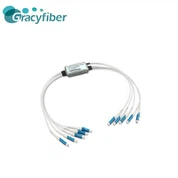
Low Light Level Multimode FWDM Module
The low-level multimode FWDM module is an optical device that can realize multiplexing and separation of optical signals of different wavelengths in multimode fibers. FWDM is the abbreviation of "Filter Wavelength Division Multiplexer", and the Chinese name is filter wavelength division multiplexer. The low-level multi-mode FWDM module refers to a FWDM module that realizes multiplexing and separation of multiple wavelength optical signals in multi-mode fiber, and has low insertion loss.

- Product Introduction
The low-level multimode FWDM module is an optical device that can realize multiplexing and separation of optical signals of different wavelengths in multimode fibers. FWDM is the abbreviation of "Filter Wavelength Division Multiplexer", and the Chinese name is filter wavelength division multiplexer. The low-level multi-mode FWDM module refers to a FWDM module that realizes multiplexing and separation of multiple wavelength optical signals in multi-mode fiber, and has low insertion loss.
Compared with high-level FWDM modules, low-level multi-mode FWDM modules use lower optical power and are suitable for short-distance transmission and low-power application scenarios. The module is usually composed of multiple filters, and each filter can filter and multiplex optical signals of specific wavelengths by selecting different central wavelengths, thereby realizing multiplexing and separation of multiple optical signals. Low-level multi-mode FWDM modules are widely used in optical communication and data centers and other fields.
Product Features
1. Low insertion loss: The low-level multimode FWDM module has low insertion loss, which can meet the needs of short-distance transmission and low-power application scenarios.
2. Multi-wavelength multiplexing: The low-level multi-mode FWDM module can realize multiplexing and separation of optical signals of multiple wavelengths in multi-mode optical fibers, which improves the transmission efficiency and bandwidth utilization of optical fibers.
3. High-throughput: low-level multi-mode FWDM module can process multiple signals at the same time, greatly improving the efficiency and speed of data transmission.
4. High stability: The low light level multi-mode FWDM module adopts high-quality materials and manufacturing processes, has high stability and reliability, and can work in harsh environments.
5. Easy to install and maintain: The installation and maintenance of the low-light level multimode FWDM module is very simple, without complicated debugging and configuration, which can greatly reduce the user's use cost.
Product Image


Product Applications
1. Optical communication: Low-level multi-mode FWDM modules are widely used in the field of optical communication to realize multiplexing and separation of multiple optical signals and improve the efficiency and bandwidth utilization of optical fiber transmission.
2. Data center: In data center, low light level multi-mode FWDM module can be used for high-speed data transmission and network connection, improving data transmission efficiency and speed.
3. Broadcast TV: Low-light level multi-mode FWDM modules can be used in the field of broadcast TV, used for optical fiber transmission of audio and video signals, and improve transmission efficiency and signal quality.
4. Industrial automation: Low-light level multi-mode FWDM modules can be applied in the field of industrial automation to transmit control signals and sensor data to improve the reliability and stability of industrial automation systems.
5. Medical and health: Low-light level multi-mode FWDM modules can be used in the medical and health field to transmit medical images and data, improving the efficiency and security of medical data transmission.
Product Parameters
| Transmission loss (insertion loss) | ≤1.5 dB | Return Loss | ≥50 dB |
| Channel Isolation | ≥30 dB | Operating wavelength range | 1260 nm – 1650 nm |
| Number of Channels | 4/8/16 | Fiber Type | Multimode Fiber |
| Input and output fiber diameter | 50/62.5/100 μm | Dimensions | 1U 19-inch standard rack |
| Operating temperature range | -40°C to +85°C |
Instructions For Use
1. Confirm the required wavelength: The low-level multimode FWDM module can realize the multiplexing and separation of optical signals of different wavelengths. The user needs to confirm the required wavelength range first, and then select the corresponding module.
2. Install the module: Insert the low-level multi-mode FWDM module into the multi-mode fiber connector, and then insert the connector into the corresponding interface. Pay attention to avoid reverse insertion and crooked insertion.
3. Connect the optical fiber: Connect the optical fiber to be transmitted to the input port of the low-level multimode FWDM module, and connect the optical fiber at the output port to the corresponding equipment, such as optical fiber transceiver, optical fiber amplifier, etc.
4. Commissioning and testing: After the installation is completed, commissioning and testing are required to ensure the normal operation and transmission quality of the low light level multimode FWDM module. Users can use optical power meters, spectrometers and other test equipment for testing and monitoring.
Terms Of Use
1. Select the correct module: Low-level multi-mode FWDM modules can realize multiplexing and separation of optical signals of different wavelengths. It is necessary to select the correct module to meet the required wavelength range.
2. Avoid reverse and crooked insertion: When installing modules, care should be taken to avoid reverse and crooked insertion, so as not to damage the modules and equipment.
3. Avoid excessive bending of optical fibers: When connecting optical fibers, it is necessary to avoid excessive bending of optical fibers, so as not to damage the optical fibers and affect the transmission quality.
4. Avoid high temperature and humid environment: Low light level multi-mode FWDM modules have certain requirements on temperature and humidity. It is necessary to avoid placing the module in a high temperature and humid environment, so as not to affect the stability and reliability of the module.
5. Avoid excessive pulling of the optical fiber: During use, it is necessary to avoid excessive pulling of the optical fiber, so as not to damage the optical fiber and affect the transmission quality.
6. Correct use of test equipment: When debugging and testing, users need to use correct test equipment to ensure the accuracy and reliability of test results.
Customer Comments
Optical communications engineer Anna Smith commented:
Fiber network installer Javier Hernandez commented:
Optical communications engineer Marta Gonzalez commented:
Optical engineer Hiroki Tanaka commented:
Abdul Rahman, fiber optic technical support engineer, commented:
Related Blogs
Product Video