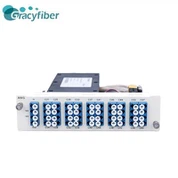
Athermal Passive AWG DWDM Low PMD Module
Our heat-free passive AWG DWDM low-PMD module is a high-performance optical module with the characteristics of no heat effect, passive drive, and low PMD. It can be widely used in the fields of optical communication and optical network. This product adopts advanced AWG technology, has the advantages of high channel quantity, high channel spacing, wide wavelength range, etc., and can realize high-speed and high-bandwidth optical transmission to meet the needs of different users.

- Product Introduction
Our heat-free passive AWG DWDM low-PMD module is a high-performance optical module with the characteristics of no heat effect, passive drive, and low PMD. It can be widely used in the fields of optical communication and optical network. This product adopts advanced AWG technology, has the advantages of high channel quantity, high channel spacing, wide wavelength range, etc., and can realize high-speed and high-bandwidth optical transmission to meet the needs of different users.
The product also features low PMD, which can effectively reduce signal dispersion and loss, and improve transmission quality and distance. The product is designed with no thermal effect, which can eliminate the adverse effects caused by thermal effect and improve stability and performance. The product also adopts a compact design, which can save space and cost, and is convenient for users to use and install. If you are interested in this product or have any questions and needs, please feel free to contact us, we will wholeheartedly provide you with quality products and services.
Product Features
1. High number of channels: The module adopts advanced AWG technology and can provide up to 40 channels to meet the needs of different users.
2. High channel spacing: The channel spacing of this module is 100GHz, which can realize high-speed and high-bandwidth optical transmission.
3. Wide wavelength range: The module supports C-band and L-band, covering the wavelength range from 1525nm to 1615nm, which can be applied to different optical network requirements.
4. Passive drive: The module adopts passive drive technology, without external power supply and temperature control, which can greatly reduce operation and maintenance costs and maintenance difficulties.
5. Low PMD: This module has the characteristics of low PMD, which can effectively reduce the dispersion and loss of the signal, and improve the transmission quality and distance.
6. No heat effect: The module adopts no heat effect design, which can eliminate the adverse effects caused by heat effect and improve stability and performance.
7. Compact design: The module adopts a compact design, which can save space and cost, and is convenient for users to use and install.
8. Safety performance: The module complies with RoHS, CE, FCC, UL and other product certification standards, ensuring the safety performance of the product.
Product Image

Product Applications
1. Communication network: This product can be widely used in the field of optical communication, including application scenarios such as optical fiber communication, optical fiber transmission, and optical fiber access. Its characteristics of high channel quantity and high channel spacing can meet the needs of different users for high-speed and high-bandwidth optical communication.
2. Data center: This product can be used in the optical interconnection of data center to realize high-speed and high-density data transmission. Its low PMD feature can improve data transmission quality and distance, and ensure data security and stability.
3. Cable TV: This product can be used in the transmission of cable TV network to realize high-definition and high-quality video transmission. Its wide wavelength range can adapt to the video transmission requirements of different frequency bands.
4. Optical testing: This product can be used in optical testing instruments to achieve high-precision and high-stability testing. Its non-thermal effect and compact design can guarantee the accuracy and reliability of test results.
Product Parameters
| Number of channels | 40 channels | Channel Spacing | 100 GHz |
| Wavelength range | C-band and L-band | Insertion Loss | ≤ 5 dB |
| Out-of-band rejection | ≥ 30 dB | PMD | ≤ 0.5 ps |
| PDL | ≤ 0.25 dB | Coherent Crosstalk | ≤ -25 dB |
Instructions For Use
1. Installation: Install the module in a suitable position to ensure that it is connected correctly with other devices. Pay attention to avoid strong light directly shining on the module, so as not to affect its performance.
2. Connection: Connect the module with other equipment, such as optical fiber, amplifier, receiver, etc. Note that the connection direction and interface type should match those of other devices to avoid connection errors.
3. Configuration: Configure the module according to actual needs, such as wavelength selection, frequency band setting, channel number, etc. The module can be configured through the terminal device, or through the web interface.
4. Debugging: After the configuration is completed, debug the module to ensure its normal performance and function. The module can be tested by optical power meter, spectrometer and other equipment to check its performance.
5. Use: After the commissioning is completed, the module can be put into use. Optical transmission and data transmission can be carried out according to actual needs to achieve high-speed, high-bandwidth transmission effects.
Terms Of Use
1. Optical fiber connection: When performing optical fiber connection, attention should be paid to the interface type of the optical fiber, the length, loss and other parameters of the optical fiber to ensure the quality and reliability of the connection.
2. Temperature environment: The module adopts passive design and does not require external power supply and temperature control, but it is still necessary to avoid excessively high or low temperature environment, so as not to affect its performance.
3. Optical power: When using this module, you should pay attention to the size and stability of the optical power, and avoid the optical power being too high or too low, so as not to affect its performance and life.
4. Spectral range: This module supports C-band and L-band, and the appropriate wavelength range should be selected according to actual needs to ensure transmission effect and performance.
5. Maintenance: When using the module, it should be maintained and maintained regularly, such as cleaning, checking and replacing parts, etc., to ensure its performance and life.
6. Safety: When using this module, you should pay attention to safety and avoid exposing it to strong light to avoid damage to human eyes.
Customer Comments
A communications engineer in Sao Paulo, Brazil commented:
Optical communication experts in Los Angeles, USA commented:
A communication engineer in Tokyo, Japan commented:
An optical communication consultant in Munich, Germany commented:
A communication engineer in Vancouver, Canada commented:
Related Blogs
Product Video