Passive Optical Attenuator-FC/UPC Optical Fiber Attenuator
Our passive fiber optic attenuators are widely used in fiber optic communication, fiber optic sensing, fiber optic testing and other fields, and have been well received by users. Whether you are regulating fiber optic signal strength or need to improve the stability and reliability in fiber optic transmission, our passive fiber optic attenuators can provide you with customized solutions, welcome to consult and purchase.

- Product Introduction
Our passive fiber optic attenuators are widely used in fiber optic communication, fiber optic sensing, fiber optic testing and other fields, and have been well received by users. Whether you are regulating fiber optic signal strength or need to improve the stability and reliability in fiber optic transmission, our passive fiber optic attenuators can provide you with customized solutions, welcome to consult and purchase.
Passive fiber optic attenuators are passive components used to regulate the strength of fiber optic signals without the need for external power or control signals, and can precisely adjust the strength of fiber optic signals without affecting the signal quality. Our passive fiber optic attenuators use high quality optical components and precision processing to provide accurate attenuation value adjustment and high stability of signal transmission. The insertion loss and return loss of the products are in accordance with international standards and can meet the needs of different application scenarios.
Product Features
1. High precision: The attenuation value can be precisely adjusted to meet different signal strength requirements.
2. High stability: Adopt high quality optical components and precision processing technology to ensure the stability and reliability of signal transmission.
3. High durability: Adopting high quality materials and technology, it can be used stably in different environments and has a long service life.
4. High cost performance: the product is reasonably priced, stable and reliable, and is an excellent fiber optic signal conditioning component.
Product Image

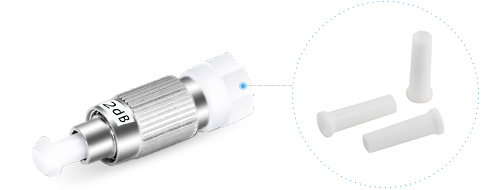
Product Applications
1. Fiber optic communication: In fiber optic communication system, passive fiber optic attenuator can be used to adjust the fiber optic signal strength, balance the optical power distribution, and improve the reliability and stability of signal transmission. It can be applied to fiber optic transmission, fiber optic amplification, fiber optic switching, fiber optic sensing and other fields.
2. Fiber optic sensing: In fiber optic sensing system, passive fiber attenuator can be used to adjust the sensitivity and dynamic range of the fiber optic sensor and optimize the measurement performance of the sensor. It can be applied to fiber optic temperature sensing, fiber optic pressure sensing, fiber optic displacement sensing and other fields.
3. fiber optic test: in fiber optic test system, passive fiber attenuator can be used to simulate different fiber distances and attenuation values to test the performance and reliability of fiber optic transmission. It can be applied to fiber optic endface inspection, fiber loss testing, fiber reflection testing and other fields.
4. optical instruments: in optical instruments, passive fiber attenuator can be used to adjust the intensity of the light source and the balance of the optical path to optimize the performance and accuracy of the instrument. It can be applied to spectrometer, optical microscope, optical amplifier and other fields.
Product Parameters
| Wavelength Range | 0.12 - 2.2 microns | Operating Temperature Range | -40°C ~ +75°C |
| Attenuation Value Range | 0 - 30dB | Aperture Diameter | 1.25mm, 2.5mm, FC, SC, ST, LC, etc. |
| Surface quality | 20/10 (standard) | Linearity | ≤±0.05dB |
| Optical Loss | ≤0.5dB | Insertion Loss Temperature Stability | ≤±0.2dB (-40°C ~ +75°C) |
| Reflection loss | ≤-50dB | Temperature Stability of Reflection Loss | ≤±0.2dB (-40°C ~ +75°C) |
Instructions For Use
1. Determine the required attenuation value according to the signal strength to be adjusted. Usually, the attenuation value of passive fiber optic attenuator ranges from 0-30dB, which can be selected according to the requirement.
2. Connect the fiber optic port where the signal strength needs to be adjusted to the input port of the passive fiber optic attenuator, and connect the output port to the receiver or the next level device.
3. Adjust the attenuation value to the desired value by rotating the attenuation adjuster on the passive fiber attenuator. Note that the attenuation value should be adjusted by rotating the attenuator to the minimum value first, and then gradually increase to the desired value to avoid damaging the device.
4. After adjusting the attenuation value, use the test instrument or equipment to check the signal strength and quality to ensure the stability and reliability of the signal transmission.
Terms Of Use
1. Avoid excessive rotation of the attenuator: Passive fiber optic attenuator is a passive component that does not require external power or control signals, so excessive rotation of the attenuator should be avoided during use to avoid damage to the device.
2. The effect of temperature change on performance: The performance of passive fiber optic attenuator is greatly affected by temperature change, which will cause the material properties of optical components to change, thus affecting the performance of the attenuator. When using passive fiber optic attenuator should keep the ambient temperature as stable as possible.
3. Cleaning and maintenance: Passive fiber attenuator will be affected by dust and dirt during use, so it needs to be cleaned and maintained regularly. When cleaning and maintaining passive fiber attenuators, avoid using corrosive chemicals and excessive force cleaning methods to avoid affecting the performance and life of the device.
4. Pay attention to device specifications and compatibility: When purchasing passive fiber optic attenuators, you should select the appropriate specifications and models according to the specific application scenarios and equipment requirements to ensure the compatibility and performance stability of the devices.
Customer Comments
A communications engineer from California, USA - George said:
Anna, an optical engineer from Munich, Germany, said:
An optical researcher from Paris, France - Pierre said:
A communications engineer from Tokyo, Japan - Ito said:
Scientist-David from Sydney, Australia said:
Related Blogs
Product Video