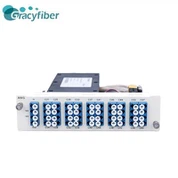
Multi-Channel Dwdm Oadm Card
Multi-channel high-wavelength-dense wavelength division multiplexer, MC-HD-WDM for short, is a high-efficiency, high-bandwidth optical communication device. Improve fiber utilization and transmission efficiency.

- Product Introduction
Multi-channel high-wavelength-dense wavelength division multiplexer, MC-HD-WDM for short, is a high-efficiency, high-bandwidth optical communication device. Improve fiber utilization and transmission efficiency.
In the traditional wavelength division multiplexing technology, there is usually a certain interval between the wavelengths of each channel, so the bandwidth resources of the optical fiber cannot be fully utilized. MC-HD-WDM adopts a high wavelength density design, which narrows the interval between channel wavelengths, and can transmit more signals to one optical fiber, thereby improving the utilization rate and transmission efficiency of optical fibers.
MC-HD-WDM can support the transmission of multiple channels at the same time, the number of channels can reach dozens or even hundreds, and the wavelength of each channel can be selected between 1270nm and 1610nm, which can meet different transmission requirements. MC-HD-WDM adopts high-precision manufacturing process and advanced packaging technology, which has extremely high reliability and stability, and can be widely used in data centers, telecom operators, Internet service providers and other fields to provide users with high-speed, high-efficiency , High-quality data transmission services.
Product Features
1. Multi-channel transmission: The multi-channel high-wavelength dense wavelength division multiplexer supports multi-channel transmission, up to 128 channels, which can meet the transmission needs of different users.
2. High wavelength density: High wavelength density design can significantly improve the utilization rate of optical fiber. The wavelength of each channel can be selected between 1270nm and 1610nm, which can meet different transmission requirements.
3. High-precision manufacturing process: The multi-channel high-wavelength dense wavelength division multiplexer adopts high-precision manufacturing process to ensure the stability and accuracy of the signal, and can provide high-quality data transmission services.
4. Advanced packaging technology: Adopting advanced packaging technology, it has extremely high reliability and stability, which can meet various complex transmission environments and ensure the reliability and stability of data transmission.
Product Image


Product Applications
1. Data center: Multi-channel high-wavelength dense wavelength division multiplexer can provide high-speed, efficient and high-quality data transmission services for data centers, and can be widely used in server interconnection, data backup, data recovery and other scenarios in data centers.
2. Telecom operators: Multi-channel high-wavelength dense wavelength division multiplexers can provide high-speed, high-efficiency, and high-quality optical transmission services for telecom operators, and can be widely used in optical transmission, optical switching and other scenarios of optical communication networks.
3. Internet service providers: multi-channel high-wavelength dense wavelength division multiplexers can provide high-speed, efficient, and high-quality data transmission services for Internet service providers, and can be widely used in Internet data center interconnection, data backup, and data recovery Wait for the scene.
4. Healthcare: Multi-channel high-wavelength dense wavelength division multiplexers can provide high-speed, efficient, and high-quality data transmission services for the healthcare industry, and can be widely used in scenarios such as medical image transmission, medical data backup, and medical data recovery.
5. Financial industry: Multi-channel high-wavelength dense wavelength division multiplexers can provide high-speed, efficient, and high-quality data transmission services for the financial industry, and can be widely used in scenarios such as financial transaction data transmission, financial data backup, and financial data recovery.
Product Parameters
| Number of channels | 16/32/40/80 | Wavelength range | 1528.77~1563.86nm or 1563.86~1603.65nm |
| Insertion Loss | < 4.5 dB | Bandwidth | 50 GHz |
| Adjacent channel isolation | > 25 dB | Non-adjacent channel isolation | > 35 dB |
| Return Loss | > 50 dB | Working temperature | 0℃ ~ 70℃ |
Instructions For Use
1. Determine the number of channels to be transmitted and the wavelength range according to actual needs, so as to correctly select the model and configuration of the multi-channel high-wavelength dense wavelength division multiplexer.
2. Install the multi-channel high-wavelength dense wavelength division multiplexer on the transmission path of the optical fiber, and connect the optical signal to be transmitted to the input port of the multiplexer.
3. According to actual needs, configure the parameters of the multi-channel high-wavelength dense wavelength division multiplexer, including parameters such as channel wavelength and power.
4. Start the multi-channel high-wavelength dense wavelength division multiplexer and conduct a test to ensure that the transmitted optical signal is stable, accurate and reliable.
Terms Of Use
1. Professional operation: The multi-channel high-wavelength dense wavelength division multiplexer is a high-precision optical transmission equipment, which needs to be operated by professionals to ensure the normal operation and stability of the equipment.
2. Prevent external force interference: During installation and use, care should be taken to avoid external force interference, and avoid external vibration or shock to the equipment, so as not to affect the stability and performance of the equipment.
3. Avoid excessive temperature: The multi-channel high-wavelength dense wavelength division multiplexer should be placed in a well-ventilated and temperature-friendly environment to avoid the impact of excessive temperature on the equipment.
4. Avoid excessive optical power: During use, care should be taken to avoid the impact of excessive optical power on the device, so as not to affect the performance and life of the device.
5. Regular inspection and maintenance: regular inspection and maintenance of the equipment to ensure the normal operation and stability of the equipment, so as to improve the service life and performance of the equipment.
Customer Comments
From Canada Data Center Manager John Smith said:
Catherine Moore, a network engineer from Australia, said:
From American network architect Michael James said:
From French sysadmin Anna Morin said:
Barbosa Ent, a network engineer from South Africa, said:
Related Blogs
Product Video